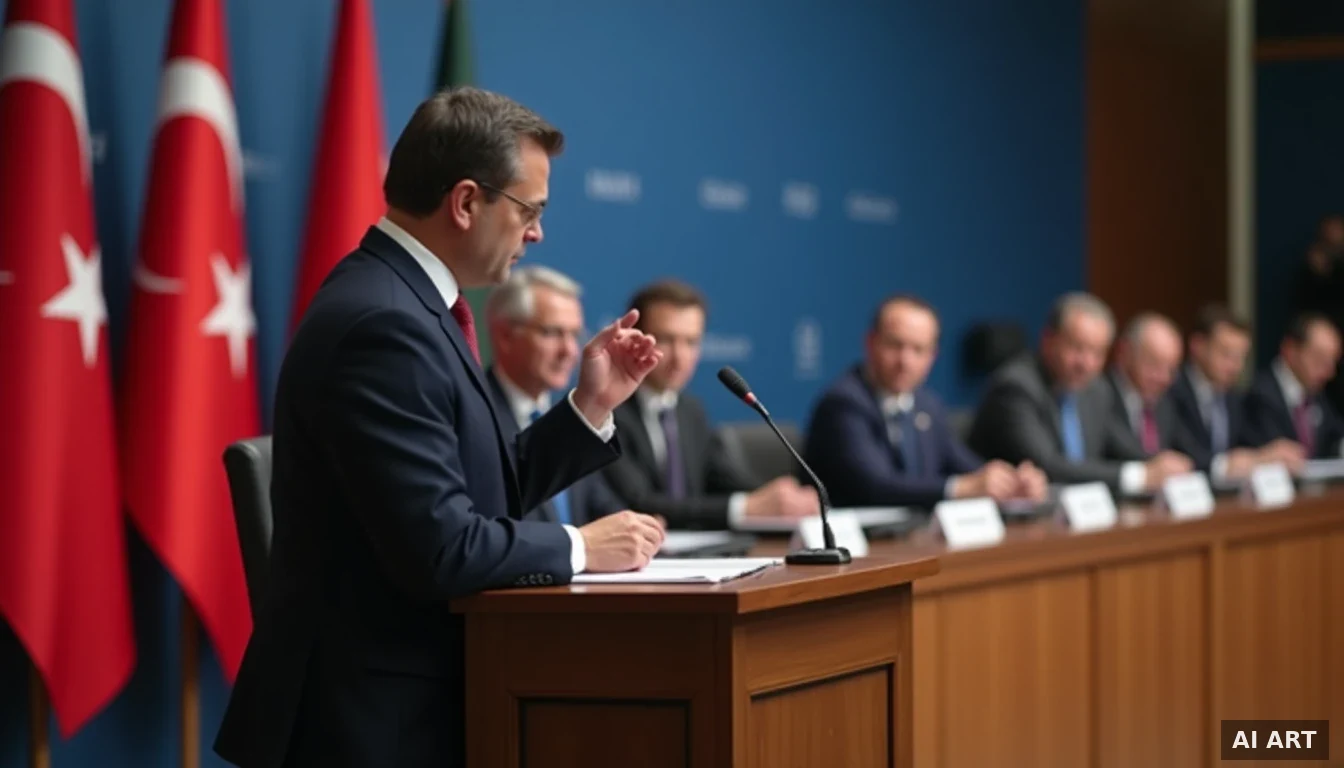
Belgian PM Calls $80B Ukraine Aid 'Red Card for Putin That Cannot Be Withdrawn' at Ankara NATO Summit
Multi-perspective analysis. Each perspective deliberately argues one viewpoint; none represents the editorial position of qalarc.
At the 2026 Ankara NATO summit, Belgian Prime Minister Bart De Wever described the alliance's new $80 billion Ukraine aid package as 'a clear red card for Putin' and 'one that cannot be withdrawn' — a pointed reference to President Donald Trump's admitted request that FIFA overturn U.S. striker Folarin Balogun's red card before the USA–Belgium World Cup match. The summit itself saw Trump clash with allies, issue fresh threats to Iran, and single out Spain as a 'terrible partner,' even as NATO closed ranks behind Ukraine.
What the terms mean (4)
- Bart De Wever — Belgian Prime Minister and leader of the Flemish nationalist N-VA party, who made the 'red card for Putin' remark at the summit.
- Folarin Balogun — U.S. men's national team striker whose World Cup red card Trump reportedly asked FIFA to review before the USA–Belgium match.
- Wesley Clark — Retired U.S. Army general and former NATO Supreme Allied Commander Europe, who warned that a Trump command restructuring would benefit the Kremlin.
- $80 billion Ukraine aid package — The defense-support pledge NATO allies agreed at the 2026 Ankara summit, which De Wever likened to an un-withdrawable red card against Putin.
The facts (8)
- The 2026 Ankara NATO summit — the 36th NATO summit and Turkey's second — was held 7–8 July 2026 at the Presidential Complex. [3]
- On 8 July 2026, Belgian PM Bart De Wever said the $80 billion Ukraine aid package was 'a clear red card for Putin' and 'one that cannot be withdrawn.' [1]
- The remark referenced Trump's admitted request that FIFA review Folarin Balogun's red-card suspension before the USA–Belgium Round of 16 match; FIFA overturned it, but Belgium still won 4-1, eliminating the USA. [2]
- De Wever himself clarified that he and Trump 'weren't at the same table' and did not discuss the match, tempering framing that he mocked Trump 'to his face.' [1][10]
- Trump attended the summit, met Erdoğan and Zelensky, declared the Iran ceasefire 'over,' and called Spain/Madrid a 'terrible partner in NATO.' [5]
- On 2 July 2026, Trump posted that the U.S. spends more on NATO than any country 'without getting any benefit,' calling it 'Ridiculous!' [4]
- Former NATO Supreme Allied Commander Wesley Clark argued (reported March 2025) that a Trump plan to restructure U.S. combatant commands would decouple the U.S. from NATO, saying 'nothing would make the Kremlin happier.' [7]
- Anti-NATO mobilizations, including 'No to NATO 2026' and an Istanbul peace summit on 4 July linking the U.S., Israel and NATO, were organized around the Ankara summit. [9]
Context & background
NATO summits have become flashpoints for tension between Trump and European allies over burden-sharing and Ukraine. In the run-up to Ankara, Trump publicly disparaged the alliance's value to the U.S. [4], and at the summit itself he combined a $80 billion Ukraine aid pledge — framed by allies as a 'win' for Kyiv — with sharp criticism of Spain and renewed threats toward Iran. [5][6] De Wever's football metaphor drew on a genuine controversy: Trump had acknowledged asking FIFA to review Balogun's red card ahead of the USA–Belgium match, which the U.S. still lost 4-1. [2] Separately, Wesley Clark's March 2025 warning that a Trump command-structure overhaul would 'please the Kremlin' reflects a distinct, longer-running debate over U.S.–NATO decoupling. [7] These are separate threads — organized anti-imperialist activism, Trump's own NATO criticism, and policy concerns about Russia-favoring moves — rather than a single coordinated 'anti-NATO' source.
Still unresolved
- Whether De Wever intended the 'red card' line as a deliberate dig at Trump or an offhand metaphor, given his statement that they never discussed the match.
- Whether Trump's stated grievances over NATO spending will translate into concrete policy changes to the U.S. commitment beyond rhetoric.
- How the various threads circulating online — activism, Trump's criticism, and Clark's Kremlin warning — actually relate, if at all, beyond sharing the summit as a backdrop.
The same story, argued three ways. Pick an angle — the facts above stay the same.
🧭 Cui bono — who benefits?
Beneficiaries
- Anti-Western disinformation networks (state-backed and opportunistic) — Amplification of incoherent, low-quality anti-NATO messaging that poisons the well for legitimate criticism
via Vague, substance-free alarm ('anti-NATO messaging from mysterious sources') creates fog that discredits both genuine foreign-policy debate and serious investigative journalism; makes it easier to dismiss substantive critiques of NATO expansion or military spending as 'probably Russian bots'. The confusion itself is the product. - Defense contractors and NATO-aligned governments — Maintenance of threat perception without requiring evidence of actual threat
via Nebulous references to hostile actors (Moscow, North Korea) sustain baseline threat narrative; lack of specificity means claims are unfalsifiable and keep defense budgets insulated from scrutiny. The question 'where is anti-NATO messaging coming from?' implies it must be foreign, pre-empting discussion of domestic opposition to military commitments. - Attention-economy platforms — Engagement from polarized, low-information controversy
via Vague geopolitical name-dropping (Trump, McConnell, Israel, Iran reparations) without coherent narrative generates argument in comments, quote-tweets, and rage-shares; each response increases time-on-platform and ad inventory, regardless of whether anyone learns anything.
Who loses
- Citizens seeking coherent foreign-policy debate (signal drowned by noise)
- Legitimate anti-interventionist and realist foreign-policy advocates (tarred as foreign agents by association)
- Journalistic credibility (erosion of distinction between reporting and rumor)
Rivalry & conflicts of interest
- Substantive critics of US military posture (anti-war left, libertarian non-interventionists, fiscal hawks) harmed → Defense establishment and bipartisan interventionist consensus gains
conflict of interest: Lawmakers on Armed Services committees routinely hold stock in or receive donations from Lockheed Martin, Raytheon, Northrop Grumman; senior officials cycle between Pentagon, think tanks funded by defense contractors (CNAS, CSIS), and board seats. Muddying the waters around 'anti-NATO messaging' makes it easier to dismiss budget critics as useful idiots.
Ramifications (follow the chain)
- Vague threat attribution becomes self-fulfilling: inability to distinguish between genuine foreign influence and organic domestic dissent → blanket treatment of all skepticism as suspect → chilling effect on debate → actual foreign actors gain credibility by appearing to be the only ones willing to ask certain questions → validates original suspicion in circular fashion.
- Degradation of information commons → public unable to assess real geopolitical risk (Iran reparations claim, Israel-Iran 'dominance' claim both circulating without verification) → policy decisions insulated from voter pressure because voters lack shared factual baseline → executive branch and security agencies gain operational autonomy by default.
- Conflation of unrelated entities (Belgium, Wesley, The Rock alongside Moscow and North Korea) trains audiences to pattern-match on vibes rather than causation → future information operations require less sophistication to succeed → cost of manipulation drops, volume increases → trust in all sources collapses, advantage to actors who never needed trust (autocracies, paramilitaries, black-market platforms).
intentional reading Defense-aligned think tanks and narrative-management operations are deliberately seeding low-quality, scattershot 'concern' about foreign messaging to create a permission structure for content moderation and budget continuation. By poisoning the well with incoherent slop (random celebrity names next to geopolitical actors, unverifiable financial claims), they ensure that when genuine leaks or whistleblower reports about military waste or covert ops surface, platforms and editors will reflexively bin them as 'conspiracy theory'. The Israeli government benefits specifically: by circulating absurd claims ('Iran dominance', '$300B reparations'), they make real reporting on IDF operations or US military aid look like more internet noise. The goal is not to convince, but to exhaust: make the information space so polluted that audiences give up trying to discern truth and defer to official sources by default.
structural reading No coordination required. Algorithmic amplification rewards engagement over accuracy; geopolitical name-drops trigger partisan reflexes and drive shares. State actors (Russia, Iran, North Korea) have obvious incentive to sow confusion; they don't need to be competent, just persistent. Domestic partisans repackage foreign claims to dunk on rivals (Trump fans share 'deep state waste in Iran', Biden supporters share 'Trump secret North Korea deal'). Defense contractors benefit passively: every cycle of threat inflation, even incoherent inflation, ratchets baseline anxiety upward and makes their products look like insurance. Platforms have no incentive to filter low-quality geopolitical content—it's not illegal, it drives time-on-site, and moderation is expensive. The system produces fog as an emergent property; individual actors are just optimizing locally (shares, clicks, contracts, votes), and the cumulative effect is an information environment where serious foreign-policy analysis is structurally disadvantaged.
📊 Trading signals — winners & losers
Tradeable instruments most exposed to this story, inferred from the analysis above. Not financial advice — informational only, generated by AI from forum discussion and may be wrong.
📈 Likely winners
- ▲ LMTstockLockheed Martin$573.917d -5.4%✓ +13.4% since callNATO threat perception maintenance benefits defense contractors directly
- ▲ NOCstockNorthrop Grumman$563.867d -2.3%✓ +9.9% since callDefense spending sustained by vague security alarm narratives
- ▲ METAstockMeta Platforms$542.237d -6.3%✗ -16.3% since callPolarized low-information controversy drives platform engagement and ad revenue
📉 Likely losers
- ▼ NYTstockNew York Times$65.367d +2.2%✓ -12.4% since callJournalistic credibility erosion undermines traditional media subscription value
📈 Call performance — day by day
| date | price | vs entry |
|---|---|---|
| 2026-08-07 | $582.85 | +15.2% |
| 2026-08-08 | $587.95 | +16.2% |
| 2026-08-09 | $587.95 | +16.2% |
| 2026-08-10 | $587.95 | +16.2% |
| 2026-08-11 | $603.16 | +19.2% |
| 2026-08-12 | $597.77 | +18.1% |
| 2026-08-13 | $606.72 | +19.9% |
| 2026-08-14 | $598.01 | +18.2% |
| 2026-08-15 | $598.01 | +18.2% |
| 2026-08-16 | $608.68 | +20.3% |
| 2026-08-17 | $608.68 | +20.3% |
| 2026-08-18 | $593.74 | +17.3% |
| 2026-08-19 | $604.37 | +19.4% |
| 2026-08-20 | $589.15 | +16.4% |
showing last 14 of 31 days
| date | price | vs entry |
|---|---|---|
| 2026-08-07 | $567.74 | +10.7% |
| 2026-08-08 | $571.58 | +11.4% |
| 2026-08-09 | $571.58 | +11.4% |
| 2026-08-10 | $571.58 | +11.4% |
| 2026-08-11 | $577.89 | +12.6% |
| 2026-08-12 | $575.69 | +12.2% |
| 2026-08-13 | $577.32 | +12.5% |
| 2026-08-14 | $574.74 | +12.0% |
| 2026-08-15 | $574.74 | +12.0% |
| 2026-08-16 | $585.87 | +14.2% |
| 2026-08-17 | $585.87 | +14.2% |
| 2026-08-18 | $570.20 | +11.1% |
| 2026-08-19 | $584.68 | +14.0% |
| 2026-08-20 | $582.84 | +13.6% |
showing last 14 of 31 days
| date | price | vs entry |
|---|---|---|
| 2026-08-07 | $589.90 | -8.9% |
| 2026-08-08 | $592.10 | -8.6% |
| 2026-08-09 | $592.10 | -8.6% |
| 2026-08-10 | $592.10 | -8.6% |
| 2026-08-11 | $594.92 | -8.1% |
| 2026-08-12 | $599.12 | -7.5% |
| 2026-08-13 | $578.85 | -10.6% |
| 2026-08-14 | $594.97 | -8.1% |
| 2026-08-15 | $594.97 | -8.1% |
| 2026-08-16 | $589.85 | -8.9% |
| 2026-08-17 | $589.85 | -8.9% |
| 2026-08-18 | $568.97 | -12.1% |
| 2026-08-19 | $545.90 | -15.7% |
| 2026-08-20 | $546.03 | -15.7% |
showing last 14 of 31 days
| date | price | vs entry |
|---|---|---|
| 2026-08-07 | $64.77 | -13.1% |
| 2026-08-08 | $63.54 | -14.8% |
| 2026-08-09 | $63.54 | -14.8% |
| 2026-08-10 | $63.54 | -14.8% |
| 2026-08-11 | $64.80 | -13.1% |
| 2026-08-12 | $63.73 | -14.5% |
| 2026-08-13 | $63.95 | -14.2% |
| 2026-08-14 | $64.13 | -14.0% |
| 2026-08-15 | $64.13 | -14.0% |
| 2026-08-16 | $64.79 | -13.1% |
| 2026-08-17 | $64.79 | -13.1% |
| 2026-08-18 | $65.27 | -12.5% |
| 2026-08-19 | $65.67 | -11.9% |
| 2026-08-20 | $66.45 | -10.9% |
showing last 14 of 31 days
📊 See how every call has performed — the full scoreboard & API →
From the threads
The posts that drew the most replies in the source discussion — shown as posted. Reactions ranged across the spectrum; these are the ones people actually engaged with. Each quote links to its archived source thread so you can verify it; quotes we couldn't tie to a source thread are marked source unverified.
Links shared in the discussion
Primary sources the threads posted — verify independently. These sometimes point to leads other coverage misses.
Continue the discussion
Add your own take — replies are kept on this article and can be upvoted.
🔗 Related Analysis
- Trump administration criticized for Iran war and $300 billion settlement shared: israel, trump
- Hypothetical US military intervention against Israel shared: israel, trump
- Satirical claim of US-Iran peace treaty shared: israel, trump
- Trump trump-meloni shared: israel, trump
- Israel portrayed as subordinate to Iran in geopolitical balance shared: israel, trump
- Ukraine strikes Moscow refineries and Crimea railway bridge shared: moscow, trump
References
- [1] PM De Wever at NATO summit: focus on support for Ukraine, 'Red card for Russia' — VRT NWS
- [2] ◖ Belgian Prime Minister Appears To Slip In A Trump World Cup Zinger During NATO Meeting — HuffPost
- [3] ◎ 2026 Ankara NATO summit — Wikipedia
- [4] ◎ Trump's NATO pressure campaign continues as summit begins — NPR
- [5] ◖ Trump touts 'unity' with NATO allies as he departs summit he upended with new threats to Iran and Spain — NBC News
- [6] ◑ NATO summit — Trump rages at allies but hands Ukraine a win — Kyiv Independent
- [7] ◎ NATO commander: Trump command plan would please the Kremlin — The Hill
- [8] Belgian prime minister defies World Cup talk ban to mock Trump to his face — Dagens.com
- [9] No to NATO! - 2026
◖ supportive · ◗ critical · ◎ neutral wire · ◑ partisan · ⚑ state outlet
▾ Discussion
Select any text in the article to comment on that passage.