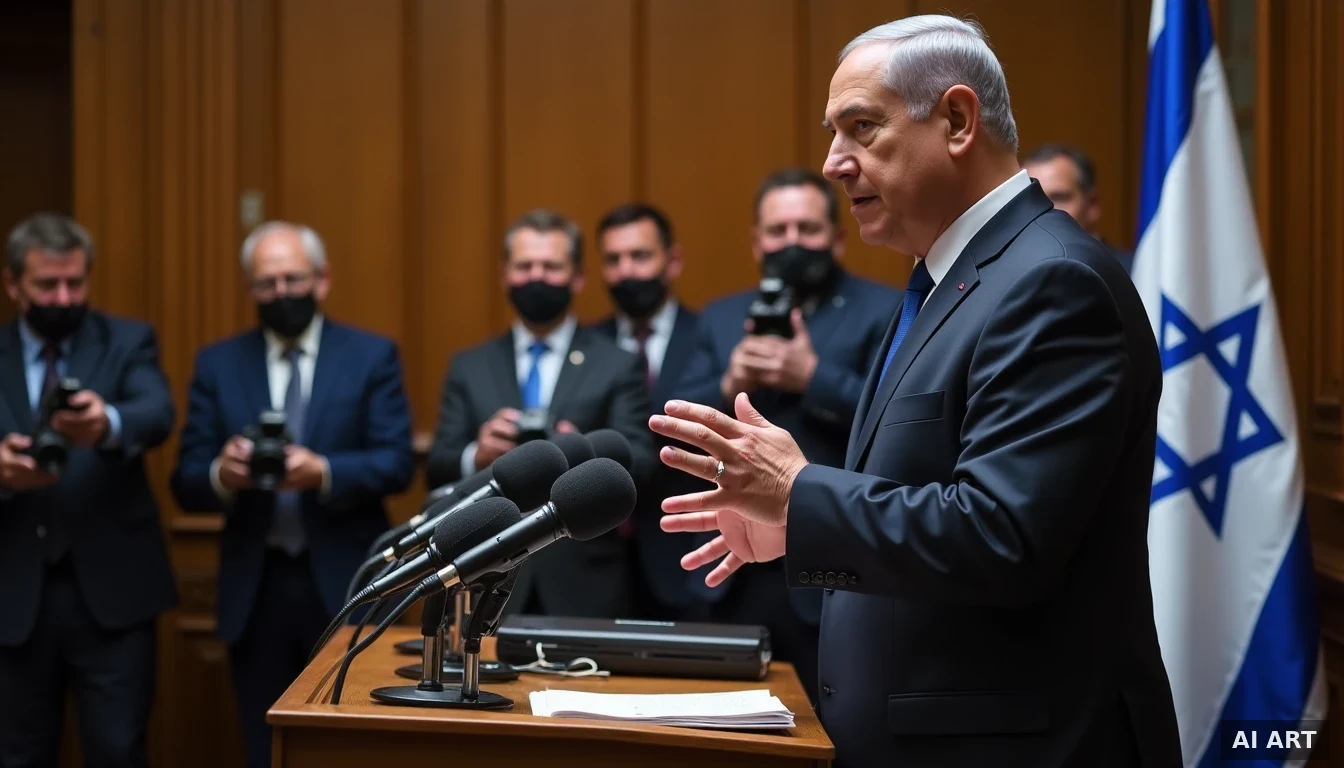
Trump-Netanyahu Friction Erupts Over Lebanon Strikes; Online Speculation Swirls About Netanyahu's Standing
Multi-perspective analysis. Each perspective deliberately argues one viewpoint; none represents the editorial position of qalarc.
After Trump confirmed in a New York Post 'Pod Force One' interview published June 3, 2026 that he called Israeli Prime Minister Benjamin Netanyahu 'f***ing crazy' during a phone call over Israel's escalation against Hezbollah in Lebanon, questions about the state of the two leaders' relationship — and Netanyahu's political standing — have intensified. Both leaders publicly downplayed any rift, and by June 19 Trump was again praising Netanyahu as a 'warrior prime minister' and signaling he'd 'most likely' endorse him in Israel's upcoming election.
What the terms mean (4)
- Pod Force One — A New York Post-affiliated podcast; Trump's interview on it, published June 3, 2026, is where he confirmed the 'crazy' remark.
- FPV drone — A 'first-person view' drone, often small and used to carry explosives; Hezbollah's use of such drones is what Israel's counter-drone project aims to defeat.
- Hezbollah — An Iran-backed Lebanese militant group and political party that Israel has fought in southern Lebanon.
- Strait of Hormuz — A strategic waterway for global oil shipping; reopening it was part of the reported June 2026 U.S.-Iran deal.
The facts (8)
- Trump confirmed in a New York Post 'Pod Force One' interview published June 3, 2026 that he called Netanyahu 'f***ing crazy' during a Monday phone call; the remarks were first reported by Axios in early June 2026. [1][4]
- The dispute centered on Israel's plan to strike Beirut amid escalation against Hezbollah; after Trump's call, Netanyahu reportedly held off on Beirut airstrikes, though ground operations in southern Lebanon continued. [3][4]
- Trump reportedly told Netanyahu he'd helped him 'stay out of jail,' with sources citing language to the effect of 'you'd be in prison if it weren't for me'; Netanyahu remains on trial for corruption and Trump has publicly urged a pardon. [1][4]
- Netanyahu downplayed any rift in a CNBC interview on June 3, 2026, calling Trump 'the greatest friend Israel has ever had in the White House' and characterizing the disagreements as 'tactical.' [2]
- On June 19, 2026, Trump praised Netanyahu as a 'warrior prime minister,' said he'd 'most likely' endorse him in Israel's upcoming (fall/October) election, but said Netanyahu needs to be 'more rational.' [5][6]
- The underlying policy split: Trump pursued diplomacy — including a U.S.-Iran arrangement to end the 2026 war and reopen the Strait of Hormuz — while Netanyahu pushed continued military pressure on Hezbollah and Iran. [3][8][14]
- Netanyahu has publicly discussed Israel's counter-drone project against Hezbollah's explosive FPV drones, a defense program he said was 'underway' but would 'take time,' referenced around May 2026 and again in late June 2026. [9][10]
- Online commentators have speculated about Netanyahu's 'status,' with some unverified discussion asserting he organized a 'false flag' to ban drones/tracking tools and that Trump uncovered a plot and withdrew from the Middle East — a narrative that does not appear in mainstream reporting, where the U.S. remained deeply engaged via Iran diplomacy and Lebanon restraint. [13][14]
Context & background
Trump and Netanyahu have a long, documented history of cooperation punctuated by periodic friction; the two have worked together since Trump's first term but have not always agreed on tactics. [12] The June 2026 strain emerged against the backdrop of the 2026 Iran war and an Israeli campaign against Hezbollah in Lebanon, with Trump prioritizing a negotiated end to hostilities — NPR reported a U.S.-Iran initial deal to end the war and reopen the Strait of Hormuz on June 15, 2026 — while Netanyahu favored sustained military pressure. [13][14] Jewish Insider characterized the relationship at the time as 'complicated,' and Newsweek framed Netanyahu as 'getting in Trump's way' in the region. [11][7] As of late June 2026, Netanyahu remains Israel's sitting prime minister while facing an election expected by October 2026 and an ongoing corruption trial.
Still unresolved
- Whether Trump will formally endorse Netanyahu ahead of Israel's expected fall election, after publicly leaving the endorsement 'hanging.'
- How durable the U.S.-Iran arrangement reported in mid-June 2026 will prove, and whether Israel will continue independent operations against Hezbollah.
- What specific private exchanges occurred during the disputed phone call, beyond the accounts attributed to anonymous sources.
The same story, argued three ways. Pick an angle — the facts above stay the same.
🧭 Cui bono — who benefits?
Beneficiaries
- Iran — Strategic autonomy and regional positioning without U.S. military pressure
via Trump's reported withdrawal from Middle East entanglements removes primary military counterweight; if U.S.-Israel relationship deteriorates, Iran faces reduced coordination between its two main adversaries and gains leverage in regional negotiations - Democratic Party / progressive coalitions — Electoral realignment as former Republican voters alienated by chaotic foreign policy
via Trump's abandonment of Netanyahu—traditionally a GOP foreign policy cornerstone—creates cognitive dissonance among evangelical and neoconservative voters; unpredictable reversals (Iran deal undermining, massive expenditure with no strategic gain) erode trust in Republican competence on national security, their historical advantage - Privacy/civil liberties advocacy sector — Ammunition against surveillance infrastructure expansion
via If Netanyahu pushed false-flag drone restrictions to enable tracking capabilities, exposure of the plot validates long-standing warnings about security theater being weaponized for control; surveillance overreach narratives gain credibility, strengthening resistance to similar measures in other jurisdictions
Who loses
- Netanyahu and Likud coalition (loss of U.S. security guarantee and diplomatic cover)
- AIPAC and pro-Israel lobbying apparatus (diminished influence if U.S.-Israel relationship substantively fractures)
- U.S. taxpayers (alleged $380B total cost between operations and reparations with no strategic return)
- Neoconservative foreign policy establishment (their Middle East framework collapsing under weight of cost and Trump's transactionalism)
Rivalry & conflicts of interest
- Netanyahu / Israeli right-wing government harmed → Iranian theocracy and IRGC gains
conflict of interest: Trump's reported pivot suggests prioritizing domestic political optics (appearing anti-endless-war) over traditional Republican alignment with Israeli hardliners; no known financial stake, but electoral calculus favors distancing from unpopular foreign commitments - Republican Party establishment (traditional pro-Israel, interventionist wing) harmed → Democratic Party gains
conflict of interest: Trump's personal brand benefits from contrarian 'deal-maker who walks away' positioning even as it undermines GOP coalition stability; his incentive is headline dominance and appearance of strength, not party institutional health
Ramifications (follow the chain)
- U.S. credibility as security guarantor declines → regional powers (Saudi Arabia, Turkey, UAE) pursue independent nuclear/defense capabilities → proliferation cascade that makes future conflict more catastrophic and U.S. influence less determinative
- AIPAC's demonstrated inability to maintain bipartisan consensus on Israel → other single-issue lobbies recognize vulnerability → decline in 'untouchable' foreign policy commitments → more transactional, less ideological U.S. foreign policy across the board
- False-flag surveillance expansion exposed → public grows more skeptical of security justifications for technology restrictions → harder for governments to ban end-to-end encryption, drones, or tracking-resistant tools using terrorism/security rationale → authoritarian governance models face higher adoption friction
- $380B expenditure with no gain becomes textbook case study → validates isolationist/'America First' narrative → accelerates U.S. retrenchment from global security provider role → China gains relative influence in resulting vacuum, particularly in Middle East energy relationships
intentional reading Netanyahu orchestrated a false-flag operation to create pretext for drone/tracking restrictions (likely to suppress monitoring of settlements or military operations), betting that Trump would reflexively support any Israeli security measure. Trump—either through intelligence briefing or independent discovery—identified the deception and, characteristically intolerant of being manipulated, performed a dramatic reversal to reassert dominance and reframe himself as the leader who 'ended endless wars.' The move serves Trump's 2024-onward narrative (populist deal-maker who won't be played) while punishing Netanyahu for overreach. Iran benefits as passive recipient of the rift, but the primary intentional actor is Trump repositioning himself, with Netanyahu as the example of an 'ally' who tried to exploit him. AIPAC becomes collateral damage, unable to bridge a personality-driven fracture.
structural reading No conspiracy required: Trump's transactional worldview naturally conflicts with ideological commitments to foreign states; $380B in costs with deteriorating approval creates political pressure to exit regardless of intelligence about false flags. Netanyahu's government, facing domestic pressure and ICC scrutiny, naturally seeks expanded surveillance/control tools and frames them as counter-terrorism—standard authoritarian playbook. Trump's base increasingly opposes foreign spending, creating electoral incentive to break from traditional GOP Israel policy. Iran gains simply by existing as the adversary while U.S.-Israel coordination breaks down through uncoordinated pursuit of incompatible self-interests: Trump needs 'wins' and cost-cutting, Netanyahu needs unconstrained action, both optimize locally and the alliance deteriorates structurally. The false-flag claim may be post-hoc rationalization for a split driven by simpler fiscal and political arithmetic.
📊 Trading signals — winners & losers
Tradeable instruments most exposed to this story, inferred from the analysis above. Not financial advice — informational only, generated by AI from forum discussion and may be wrong.
📈 Likely winners
- ▲ GCcommodityGold$4,5847d +5.1%✓ +12.2% since callGeopolitical uncertainty and potential Middle East realignment boosts safe-haven demand
- ▲ IRNTETFiShares MSCI Iran Capped ETFIran benefits from reduced U.S. military pressure, regional autonomy gains
📉 Likely losers
- ▼ CLcommodityCrude Oil$86.527d +6.5%✗ +16.6% since callU.S. Middle East withdrawal reduces conflict premium in oil pricing
- ▼ LMTstockLockheed Martin$573.917d -5.4%✗ +13.4% since callReduced U.S. Middle East engagement threatens defense contracts and aid
- ▼ NOCstockNorthrop Grumman$563.867d -2.3%✗ +9.9% since callMiddle East disengagement cuts demand for surveillance and defense systems
📈 Call performance — day by day
| date | price | vs entry |
|---|---|---|
| 2026-08-07 | $4,318 | +5.7% |
| 2026-08-08 | $4,398 | +7.6% |
| 2026-08-09 | $4,400 | +7.7% |
| 2026-08-10 | $4,400 | +7.7% |
| 2026-08-11 | $4,454 | +9.0% |
| 2026-08-12 | $4,427 | +8.3% |
| 2026-08-13 | $4,467 | +9.3% |
| 2026-08-14 | $4,416 | +8.1% |
| 2026-08-15 | $4,401 | +7.7% |
| 2026-08-16 | $4,437 | +8.6% |
| 2026-08-17 | $4,450 | +8.9% |
| 2026-08-18 | $4,460 | +9.1% |
| 2026-08-19 | $4,386 | +7.3% |
| 2026-08-20 | $4,581 | +12.1% |
showing last 14 of 31 days
| date | price | vs entry |
|---|---|---|
| 2026-08-07 | $78.07 | +5.2% |
| 2026-08-08 | $77.08 | +3.9% |
| 2026-08-09 | $78.18 | +5.4% |
| 2026-08-10 | $78.73 | +6.1% |
| 2026-08-11 | $82.21 | +10.8% |
| 2026-08-12 | $83.40 | +12.4% |
| 2026-08-13 | $82.77 | +11.5% |
| 2026-08-14 | $81.15 | +9.4% |
| 2026-08-15 | $81.41 | +9.7% |
| 2026-08-16 | $82.40 | +11.1% |
| 2026-08-17 | $82.40 | +11.1% |
| 2026-08-18 | $84.99 | +14.5% |
| 2026-08-19 | $84.54 | +13.9% |
| 2026-08-20 | $84.64 | +14.1% |
showing last 14 of 31 days
| date | price | vs entry |
|---|---|---|
| 2026-08-07 | $582.85 | +15.2% |
| 2026-08-08 | $587.95 | +16.2% |
| 2026-08-09 | $587.95 | +16.2% |
| 2026-08-10 | $587.95 | +16.2% |
| 2026-08-11 | $603.16 | +19.2% |
| 2026-08-12 | $597.77 | +18.1% |
| 2026-08-13 | $606.72 | +19.9% |
| 2026-08-14 | $598.01 | +18.2% |
| 2026-08-15 | $598.01 | +18.2% |
| 2026-08-16 | $608.68 | +20.3% |
| 2026-08-17 | $608.68 | +20.3% |
| 2026-08-18 | $593.74 | +17.3% |
| 2026-08-19 | $604.37 | +19.4% |
| 2026-08-20 | $589.15 | +16.4% |
showing last 14 of 31 days
| date | price | vs entry |
|---|---|---|
| 2026-08-07 | $567.74 | +10.7% |
| 2026-08-08 | $571.58 | +11.4% |
| 2026-08-09 | $571.58 | +11.4% |
| 2026-08-10 | $571.58 | +11.4% |
| 2026-08-11 | $577.89 | +12.6% |
| 2026-08-12 | $575.69 | +12.2% |
| 2026-08-13 | $577.32 | +12.5% |
| 2026-08-14 | $574.74 | +12.0% |
| 2026-08-15 | $574.74 | +12.0% |
| 2026-08-16 | $585.87 | +14.2% |
| 2026-08-17 | $585.87 | +14.2% |
| 2026-08-18 | $570.20 | +11.1% |
| 2026-08-19 | $584.68 | +14.0% |
| 2026-08-20 | $582.84 | +13.6% |
showing last 14 of 31 days
📊 See how every call has performed — the full scoreboard & API →
🔗 Related Analysis
- Trump potentially sabotages own Iran peace deal shared: aipac, trump
- Anti-Trump partisan attack shared: trump
- Iran military gains assertion shared: trump
- Trump military operation duration criticism shared: trump
- Criticism of perceived ignorance about Iran among a demographic group shared: trump
- Trump administration criticized for Iran war and $300 billion settlement shared: trump
References
- [1] ◎ Trump calls Netanyahu 'crazy' but says they still get along — NPR
- [2] ◎ Netanyahu downplays US-Israel rift after Trump confirms criticism — Al Jazeera
- [3] ◎ Trump acknowledges calling Netanyahu 'crazy,' says Israel is complicating peace talks with Iran — PBS News
- [4] ◖ Trump cursed at Netanyahu in call over Lebanon escalation, sources say — ABC News
- [5] ◗ Trump teases Bibi endorsement as public rift over Iran deal, Lebanon grows — Fox News
- [6] ◑ June 19: Trump calls Netanyahu 'warrior PM,' touts 'great relationship' with Israel — The Times of Israel
- [7] ◖ Netanyahu Is Getting in Trump's Way in the Middle East — Newsweek
- [8] ◖ The Alliance Trap Is Swallowing Donald Trump — Newsweek
- [9] ◑ Netanyahu says project to counter drone threat underway, but 'will take time' — The Times of Israel
- [10] ◑ Israel close to solving explosive drone issue, Netanyahu says — The Jerusalem Post
- [11] It's complicated: Trump and Netanyahu's relationship status — Jewish Insider
- [12] ◎ Trump and Netanyahu have a long history of working together but don't always agree — NPR
- [13] ◎ 2026 Iran war — Wikipedia
- [14] ◎ U.S. and Iran reach initial deal to end war, reopen Strait of Hormuz — NPR
- [15] ◎ NPR: U.S.-Iran reach initial deal to end war, reopen Strait of Hormuz — NPR
- [16] ◑ Netanyahu on Israel's counter-drone effort against Hezbollah FPV drones — The Times of Israel
- [17] ◎ Benjamin Netanyahu — Wikipedia
- [18] ◎ U.S. and Iran reach initial deal to end war, reopen Strait of Hormuz — NPR
◖ supportive · ◗ critical · ◎ neutral wire · ◑ partisan · ⚑ state outlet
▾ Discussion
Select any text in the article to comment on that passage.