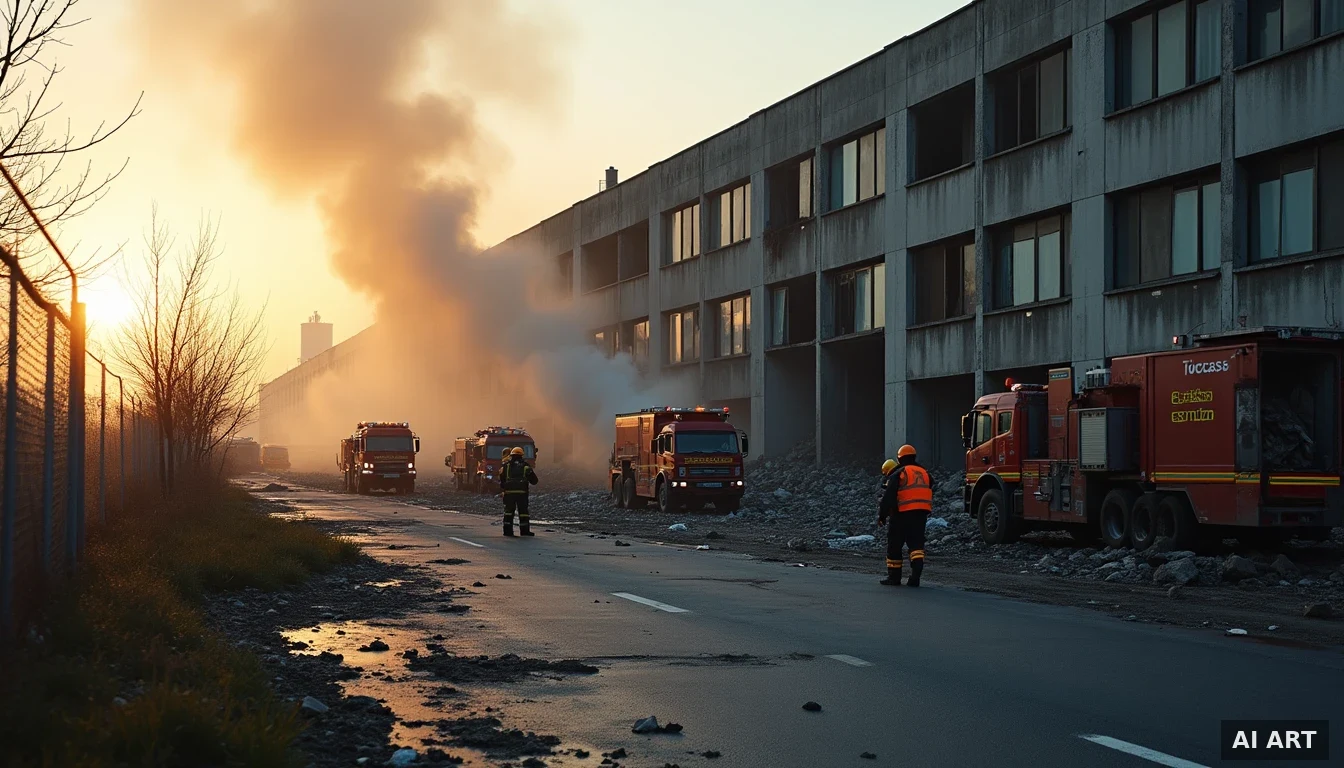
Day 1,580: Ukraine Strikes Voronezh Semiconductor Plant as Campaign to Isolate Crimea Intensifies
Multi-perspective analysis. Each perspective deliberately argues one viewpoint; none represents the editorial position of qalarc.
On June 22, 2026, Ukraine's General Staff confirmed an Air Force missile strike on the Voronezh Semiconductor Devices Plant ('Sborka'), a facility that supplies components for Russia's Kh-101 cruise missiles, Iskander-K systems and Pantsir-S1 air defenses. The strike forms part of a broader, ISW-documented Ukrainian campaign to choke fuel and logistics flowing across the Kerch Strait into occupied Crimea, even as Russia continues its own large-scale missile and drone barrages against Ukrainian energy and civilian infrastructure.
What the terms mean (5)
- Voronezh Semiconductor Devices Plant ('Sborka') — A Russian electronics factory said to produce semiconductor components used in Kh-101 cruise missiles, Iskander-K and Pantsir-S1 systems.
- ISW (Institute for the Study of War) — A Washington-based think tank that publishes daily assessments of the Russia-Ukraine war, widely cited for tracking front-line and strike activity.
- Kerch Strait / Crimean Bridge — The narrow waterway and the road-rail bridge linking the Russian mainland to occupied Crimea, a key logistics artery for Russian forces.
- Kh-101 / Iskander-K / Pantsir-S1 — Russian precision strike and air-defense systems whose production depends on specialized electronic components.
- Storm Shadow — A long-range air-launched cruise missile supplied to Ukraine by Western partners, cited by Russian sources in the Voronezh strike.
The facts (8)
- Ukraine's General Staff confirmed on June 22, 2026 an Air Force strike on the Voronezh Semiconductor Devices Plant ('Sborka'), described as a supplier of electronics for Kh-101 cruise missiles, Iskander-K and Pantsir-S1 systems [1][2].
- Voronezh Governor Alexander Gusev confirmed the attack, initially reporting at least three injured before later acknowledging casualties including some in critical condition [1].
- Russian sources cited the use of a Storm Shadow cruise missile in the strike on the Iskander-linked electronics plant [1].
- ISW's June 21, 2026 assessment describes an ongoing, systematic Ukrainian campaign to deny Russia logistics and fuel transport across the Kerch Strait, worsening fuel shortages in occupied Crimea [3].
- ISW's June 20, 2026 assessment reports Ukraine struck bridges and transport infrastructure linking occupied Kherson Oblast with Crimea, forcing Crimean rail traffic to be shortened or rerouted to Kerch [4].
- A railway bridge on the Kerch–Dzhankoi line caught fire after a reported Ukrainian strike on June 18, 2026, confirmed by Ukraine's General Staff on June 19 [5].
- The Kerch (Crimean) Bridge itself remains operational as of mid-June 2026 with significant traffic restrictions; Russia has established alternative and pontoon bypass routes [6][8].
- Separately, Russia continues large-scale strikes on Ukrainian energy and civilian infrastructure; a Dec. 23, 2025 attack involving roughly 635 drones and 38 missiles killed at least three people and caused widespread blackouts [7].
Context & background
The full-scale invasion began Feb. 24, 2022, placing 'Day 1,580' in mid-June 2026, roughly consistent with the events documented though not an exact official designation. Over the past year, Ukraine has shifted toward deep-strike operations targeting the Russian war economy — fuel refineries, logistics nodes and the supply chains feeding Russia's missile production — a strategy analysts have described as an attempt to 'strangle' Russia's war machine [10]. The Voronezh plant strike fits this pattern, hitting a node deep inside the supply chain rather than front-line forces [2]. In parallel, Ukrainian forces have repeatedly targeted the rail and road links binding occupied Crimea to the Russian mainland and to occupied southern Ukraine, including the Kerch–Dzhankoi line and crossings from Kherson Oblast, with the apparent goal of isolating the peninsula's military logistics [4][5]. Russia, which has controlled Crimea since 2014, has responded by building bypass and pontoon routes around damaged bridges [6]. Russia has meanwhile maintained its own campaign of mass missile and drone strikes on Ukrainian power and civilian infrastructure throughout late 2025 and into 2026 [9][11].
Still unresolved
- The full extent of damage to the Voronezh plant and its impact on Russian missile and air-defense production remains unconfirmed beyond initial Ukrainian and Russian statements.
- It is unclear how severely the Kerch Strait logistics disruptions are affecting Russian military supply and fuel availability in Crimea, beyond ISW's assessment of worsening shortages.
- Casualty figures from the Voronezh strike were still being updated by Russian officials at the time of reporting.
The same story, argued three ways. Pick an angle — the facts above stay the same.
🧭 Cui bono — who benefits?
Beneficiaries
- Western and East Asian semiconductor incumbents (TSMC, Samsung, Intel, Infineon, STMicroelectronics) — Elimination of nascent Eastern European chip-fabrication capacity and reinforced demand for their output
via Strikes on Ukrainian semiconductor manufacturing and Russian counterstrikes on Voronezh-area fabs remove marginal regional supply, channelling military and civilian chip demand back to established foundries and packaging houses outside the war zone - Defence primes and missile/drone manufacturers (Raytheon/RTX, Lockheed Martin, Rostec, plus Ukrainian and Turkish drone firms) — Sustained, replenishing order books for precision munitions, air defence and loitering munitions
via A reciprocal infrastructure-strike war consumes inventory on both sides; each strike on fuel depots, fabs and bridges justifies the next procurement cycle for interceptors and strike weapons - Global oil and refined-product traders (and OPEC+ exporters) — Price support and volatility premiums from damaged refining/fuel infrastructure
via Ukrainian strikes on Russian refineries (e.g. near Moscow) and Russian strikes on Ukrainian fuel supplies tighten regional product markets, widening crack spreads and rewarding traders positioned for disruption - The Institute for the Study of War (understandingwar.org) and the conflict-analysis/OSINT ecosystem — Elevated relevance, funding and policy influence
via Each escalation generates demand for granular battlefield assessment that think tanks, defence consultancies and intelligence contractors monetise via grants, subscriptions and government contracts - China as a strategic observer and arms/components supplier — A degraded Russian and Ukrainian industrial base increases dependence on Chinese dual-use components and machine tools
via As both belligerents lose domestic fab and logistics capacity, China captures supply of chips, drones parts and industrial inputs while studying Western interceptor consumption rates
Who loses
- Ukrainian civilians and industry facing degraded power, fuel and chip-dependent manufacturing
- Russian refining and logistics operators absorbing repeated strikes on fuel and rail infrastructure
- European insurers and reinsurers exposed to war-risk, energy and Black Sea shipping policies
- Any investor who bet on Ukraine or southern Russia as a future semiconductor or logistics hub
Rivalry & conflicts of interest
- Russian fuel logistics into Crimea (Kerch bridge, rail links) harmed → Ukrainian command seeking to isolate the southern front and Western defence suppliers backing them gains
conflict of interest: Western governments funding Ukrainian deep-strike capability also host the defence primes that profit from prolonged munitions demand - Ukrainian and Russian domestic semiconductor manufacturing (Voronezh plant and Ukrainian fabs) harmed → TSMC, Samsung and Western/Asian chipmakers outside the conflict zone gains
conflict of interest: Allied policymakers steering chip supply chains 'home-shoring' to friendly fabs have strategic stakes in those same foundries via subsidy programmes (CHIPS Act, EU Chips Act) - Russian energy export reliability harmed → US LNG exporters and Gulf/OPEC+ producers filling the European supply gap gains
conflict of interest: US administrations promoting Ukrainian strike latitude simultaneously champion US LNG export expansion that benefits from Russian supply disruption
Ramifications (follow the chain)
- Both sides target the other's chip fabs -> regional fabrication capacity collapses -> long-term dependence on TSMC/Samsung/Intel and Chinese suppliers deepens -> postwar reconstruction locks Ukraine into imported silicon
- Reciprocal fuel-infrastructure strikes -> regional product shortages and price spikes -> crack spreads widen -> oil traders and OPEC+ capture rents while European consumers absorb energy inflation
- Strikes on the Kerch bridge and Crimean rail -> Russian southern logistics forced onto slower, more exposed routes -> higher munitions and air-defence consumption to protect them -> sustained order flow for both sides' arms suppliers
- Escalating attritional infrastructure war -> Western interceptor stockpiles drawn down faster than replenishment -> defence primes secure multi-year contracts -> the same states funding Ukraine bankroll their own industrial base
intentional reading The strongest intentional reading: both belligerents are deliberately targeting each other's industrial deep-rear — semiconductor fabs, refineries, fuel depots and the Kerch crossing — as a calculated economic-attrition strategy rather than purely tactical battlefield action. Ukraine's strikes on the Moscow-area refinery and Crimean rail bridge aim to throttle Russian fuel and southern logistics; Russia's strikes on Ukrainian fabs and fuel aim to hollow out Ukraine's capacity to sustain and rebuild a war economy. Read cynically, the external sponsors are not neutral: Western backers who underwrite Ukrainian deep-strike capability are the same states whose defence primes profit from the resulting munitions burn rate and whose LNG and chip industries gain from disrupted Russian rivals. The conflict thus functions, intentionally or conveniently, as a market-clearing event that re-shores high-value supply chains toward allied incumbents.
structural reading No coordination is required. Each side independently concludes that hitting the other's fabs, fuel and bridges yields strategic value, so reciprocal deep strikes emerge from symmetrical incentives. Meanwhile global incumbents passively benefit: when conflict erases marginal Eastern European chip and refining capacity, demand simply reflows to TSMC, Samsung, US LNG terminals and OPEC+ without anyone steering it. Defence primes don't need to engineer escalation; attrition warfare mechanically depletes inventory and generates contracts. Think tanks and the OSINT sector grow because demand for analysis rises with intensity. The aligned self-interest of arms makers, energy exporters, chip incumbents and analysts produces a system in which prolonged infrastructure war is quietly profitable for everyone outside the blast radius.
📊 Trading signals — winners & losers
Tradeable instruments most exposed to this story, inferred from the analysis above. Not financial advice — informational only, generated by AI from forum discussion and may be wrong.
📈 Likely winners
- ▲ TSMstockTaiwan Semiconductor$414.857d -3.3%✗ -0.8% since callReduced Eastern European chip competition reinforces incumbent demand
- ▲ LMTstockLockheed Martin$573.917d -5.4%✓ +13.4% since callSustained demand for missiles and air defense systems
- ▲ RTXstockRTX Corporation$212.297d -4.7%✓ +7.9% since callOngoing precision munitions and defense replenishment orders
- ▲ CLcommodityCrude Oil$86.527d +6.5%✓ +16.6% since callRefining infrastructure strikes support price volatility premiums
- ▲ BZcommodityBrent Crude$93.227d +7.1%✓ +18.4% since callEnergy infrastructure damage creates supply risk premium
📉 Likely losers
- ▼ UKRAETFiShares MSCI Ukraine ETFDirect exposure to degraded Ukrainian industrial and power infrastructure
- ▼ ERUSETFiShares MSCI Russia ETF$8.06✓ +0.0% since callRussian logistics and refining infrastructure under repeated strikes
📈 Call performance — day by day
| date | price | vs entry |
|---|---|---|
| 2026-08-07 | $418.20 | +0.0% |
| 2026-08-08 | $420.04 | +0.5% |
| 2026-08-09 | $420.04 | +0.5% |
| 2026-08-10 | $420.04 | +0.5% |
| 2026-08-11 | $418.47 | +0.1% |
| 2026-08-12 | $422.06 | +0.9% |
| 2026-08-13 | $429.15 | +2.6% |
| 2026-08-14 | $434.50 | +3.9% |
| 2026-08-15 | $430.49 | +3.0% |
| 2026-08-16 | $426.35 | +2.0% |
| 2026-08-17 | $426.35 | +2.0% |
| 2026-08-18 | $430.97 | +3.1% |
| 2026-08-19 | $413.41 | -1.1% |
| 2026-08-20 | $412.09 | -1.4% |
showing last 14 of 31 days
| date | price | vs entry |
|---|---|---|
| 2026-08-07 | $582.85 | +15.2% |
| 2026-08-08 | $587.95 | +16.2% |
| 2026-08-09 | $587.95 | +16.2% |
| 2026-08-10 | $587.95 | +16.2% |
| 2026-08-11 | $603.16 | +19.2% |
| 2026-08-12 | $597.77 | +18.1% |
| 2026-08-13 | $606.72 | +19.9% |
| 2026-08-14 | $598.01 | +18.2% |
| 2026-08-15 | $598.01 | +18.2% |
| 2026-08-16 | $608.68 | +20.3% |
| 2026-08-17 | $608.68 | +20.3% |
| 2026-08-18 | $593.74 | +17.3% |
| 2026-08-19 | $604.37 | +19.4% |
| 2026-08-20 | $589.15 | +16.4% |
showing last 14 of 31 days
| date | price | vs entry |
|---|---|---|
| 2026-08-07 | $223.25 | +13.5% |
| 2026-08-08 | $223.03 | +13.3% |
| 2026-08-09 | $223.03 | +13.3% |
| 2026-08-10 | $223.03 | +13.3% |
| 2026-08-11 | $224.12 | +13.9% |
| 2026-08-12 | $223.86 | +13.8% |
| 2026-08-13 | $222.76 | +13.2% |
| 2026-08-14 | $220.48 | +12.0% |
| 2026-08-15 | $220.48 | +12.0% |
| 2026-08-16 | $222.97 | +13.3% |
| 2026-08-17 | $222.97 | +13.3% |
| 2026-08-18 | $221.64 | +12.6% |
| 2026-08-19 | $222.74 | +13.2% |
| 2026-08-20 | $220.35 | +12.0% |
showing last 14 of 31 days
| date | price | vs entry |
|---|---|---|
| 2026-08-07 | $78.07 | +5.2% |
| 2026-08-08 | $77.08 | +3.9% |
| 2026-08-09 | $78.18 | +5.4% |
| 2026-08-10 | $78.73 | +6.1% |
| 2026-08-11 | $82.21 | +10.8% |
| 2026-08-12 | $83.40 | +12.4% |
| 2026-08-13 | $82.77 | +11.5% |
| 2026-08-14 | $81.15 | +9.4% |
| 2026-08-15 | $81.41 | +9.7% |
| 2026-08-16 | $82.40 | +11.1% |
| 2026-08-17 | $82.40 | +11.1% |
| 2026-08-18 | $84.99 | +14.5% |
| 2026-08-19 | $84.54 | +13.9% |
| 2026-08-20 | $84.64 | +14.1% |
showing last 14 of 31 days
| date | price | vs entry |
|---|---|---|
| 2026-08-07 | $83.43 | +6.0% |
| 2026-08-08 | $82.27 | +4.5% |
| 2026-08-09 | $83.55 | +6.1% |
| 2026-08-10 | $84.29 | +7.0% |
| 2026-08-11 | $87.62 | +11.3% |
| 2026-08-12 | $89.44 | +13.6% |
| 2026-08-13 | $88.61 | +12.5% |
| 2026-08-14 | $86.55 | +9.9% |
| 2026-08-15 | $86.55 | +9.9% |
| 2026-08-16 | $88.52 | +12.4% |
| 2026-08-17 | $88.52 | +12.4% |
| 2026-08-18 | $90.85 | +15.4% |
| 2026-08-19 | $90.83 | +15.4% |
| 2026-08-20 | $91.63 | +16.4% |
showing last 14 of 31 days
| date | price | vs entry |
|---|---|---|
| 2026-08-07 | $8.06 | +0.0% |
| 2026-08-08 | $8.06 | +0.0% |
| 2026-08-09 | $8.06 | +0.0% |
| 2026-08-10 | $8.06 | +0.0% |
| 2026-08-11 | $8.06 | +0.0% |
| 2026-08-12 | $8.06 | +0.0% |
| 2026-08-13 | $8.06 | +0.0% |
| 2026-08-14 | $8.06 | +0.0% |
| 2026-08-15 | $8.06 | +0.0% |
| 2026-08-16 | $8.06 | +0.0% |
| 2026-08-17 | $8.06 | +0.0% |
| 2026-08-18 | $8.06 | +0.0% |
| 2026-08-19 | $8.06 | +0.0% |
| 2026-08-20 | $8.06 | +0.0% |
showing last 14 of 31 days
📊 See how every call has performed — the full scoreboard & API →
From the threads
The posts that drew the most replies in the source discussion — shown as posted. Reactions ranged across the spectrum; these are the ones people actually engaged with. Each quote links to its archived source thread so you can verify it; quotes we couldn't tie to a source thread are marked source unverified.
Does anyone remember how pussians tried to make their own temu version of marichka?
Previous: Day 1,580 – Daily assessment: understandingwar.org/analysis/russi a-ukraine/#research ▶Latest ▶Telegram rentry.org/telosint2023 t.me/ukr_pics ▶Intel t.me/DeepStateEN odin.tradoc.army.mil/WEG (equipment explorer) ukr.warspotting.net (visually confirmed losses) ▶Maps deepstatemap.live/en liveuamap.com/en ▶DISPOSABLE SOLDIER (diary of a RU mobik) TOURS 1-4: https://files.catbox.moe/19avc9.zip ▶russian confirmed KIA updated daily: https://hochuvernut.com/
Previous: Day 1,580 – Daily assessment: understandingwar.org/analysis/russi a-ukraine/#research ▶Latest ▶Telegram rentry.org/telosint2023 t.me/ukr_pics ▶Intel t.me/DeepStateEN odin.tradoc.army.mil/WEG (equipment explorer) ukr.warspotting.net (visually confirmed losses) ▶Maps deepstatemap.live/en liveuamap.com/en ▶DISPOSABLE SOLDIER (diary of a RU mobik) TOURS 1-4: https://files.catbox.moe/19avc9.zip ▶russian confirmed KIA updated daily: https://hochuvernut.com/
The n***** cattle are questioning the current events, but their n***** cattle mind will never revolt.
Links shared in the discussion
Primary sources the threads posted — verify independently. These sometimes point to leads other coverage misses.
- hochuvernut.comshared 2×
- files.catbox.moeshared 2×
- bbc.co.ukshared 2×
Continue the discussion
Add your own take — replies are kept on this article and can be upvoted.
🔗 Related Analysis
- Ukraine strikes Moscow refineries and Crimea railway bridge shared: crimea, understandingwar org
References
- [1] ◑ Ukrainian Storm Shadow Hit Iskander-Linked Electronics Plant, Say Russian Sources — Kyiv Post
- [2] Ukraine hits the factory inside Russia's missile supply chain — defence-blog
- [3] ◑ ISW Russian Offensive Campaign Assessment, June 21, 2026 — Kyiv Post
- [4] ISW Russian Offensive Campaign Assessment, June 20, 2026 — Critical Threats
- [5] ◑ Key railway bridge in occupied Crimea in flames after reported Ukrainian strike — Kyiv Independent
- [6] ◑ Russians Establish Alternative Routes Bypassing Damaged Bridges to Crimea — Militarnyi
- [7] ◎ Crimean Bridge — Wikipedia
- [8] ◎ Russian strikes against Ukrainian infrastructure — Wikipedia
- [9] Cutting the Fuel Line: Ukraine's Bid to Strangle Russia's War Economy — Modern Diplomacy
- [10] ◑ Ukraine says 'massive' Russian attack targeted energy infrastructure — CNN
- [11] ◑ 'Massive' Russian strikes prompt power cuts across Ukraine, Zelenskyy says — ABC News
◖ supportive · ◗ critical · ◎ neutral wire · ◑ partisan · ⚑ state outlet
▾ Discussion
Select any text in the article to comment on that passage.